

A wave of severe hardware and software security threats has unsettled the digital asset ecosystem, led by revelations that a sophisticated physical supply-chain breach targeting Ledger hardware wallets has expanded beyond Southeast Asia into mainstream European retail channels.
Hardware wallet security relies heavily on tamper-resistant microcontrollers designed to secure private cryptographic seeds offline. That perimeter failed across Southeast Asia after modified units sourced from CryptoBilis—an authorized distributor serving Malaysia, Indonesia, and the Philippines—began intercepting secret recovery phrases. Cybersecurity tracker Yfarmx linked the compromised units to an estimated $93.4 million siphoned across 471 wallet addresses. Attackers altered internal circuits while preserving the device firmware’s ability to clear official authenticity checks.
The threat perimeter broadened this week when a European buyer using the alias Johannes disclosed hardware photographs of a manipulated Ledger unit obtained directly from electronics retailer MediaMarkt. Technical inspection showed an internal rogue module. Former Mt Gox CEO Mark Karpeles, who analyzed the Asian hardware alterations, noted that internal antenna configurations match a Eurasian cellular profile, suggesting whoever orchestrated the scheme produced specialized hardware variations calibrated to different regional transmission standards.


Ledger responded by directing CryptoBilis to freeze all order fulfillment and advised anyone who acquired hardware through that reseller over the preceding quarter to migrate their funds immediately. While Ledger maintains that overall unit exposure remains strictly contained, the appearance of an altered device on European store shelves represents a troubling escalation from targeted regional distributor tampering to broad commercial retail channels.
Simultaneously, code-level vulnerabilities came under scrutiny after automated code inspection tools uncovered a critical flaw in Ripple’s underlying infrastructure. Software security firm Veria Labs collected a $250,000 bounty after discovering a dormant integer overflow bug residing inside rippled, the core codebase sustaining the XRP Ledger since 2015.
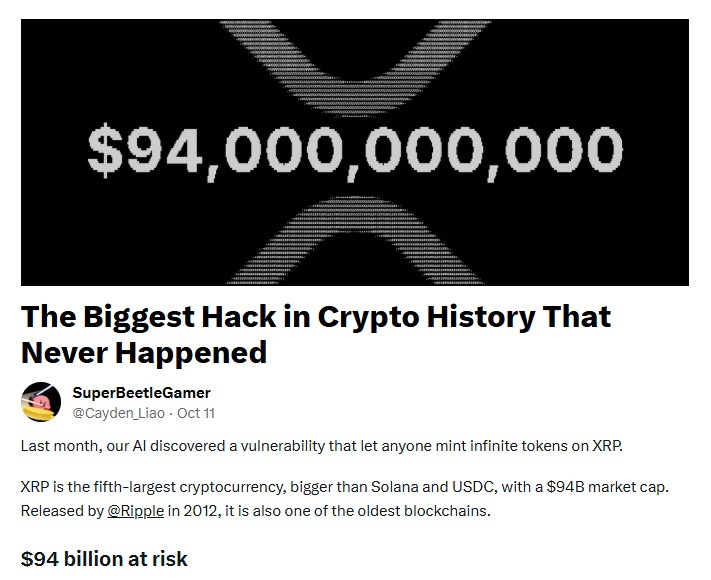
Veria Labs co-founder Cayden Liao revealed that an artificial intelligence auditing agent isolated two distinct low-severity flaws that could be executed together within a single transaction. Had an adversary deployed the sequence before RippleX pushed an emergency fix on September 25, the vulnerability could theoretically have minted more than 18 trillion unauthorized XRP, placing the network’s entire valuation in jeopardy.
The deployment of machine intelligence to probe cryptographic systems has stirred broader philosophical debate among core network architects. Ethereum researcher Justin Drake warned that machine learning acceleration could untangle complex mathematical proofs faster than anticipated, urging developers to construct contingency protocols dubbed bunker mode to protect foundational blockchain encryption before post-quantum standards become mandatory.

Ethereum co-founder Vitalik Buterin voiced support for Drake’s technical vigilance. While cautioning users against panicked fund movements, Buterin acknowledged that computational breakthroughs pose genuine systemic risks to legacy elliptic curve configurations.
Amid structural and cryptographic concerns, legal pressure continues to reshape early-era crypto executive liabilities. Former Celsius CEO Alex Mashinsky received a lifetime prohibition barring him from operating across New York commodities, securities, and cryptocurrency markets. The consent order negotiated by Attorney General Letitia James resolved civil fraud charges tied to the 2022 insolvency of Celsius Network, imposing up to $35 million in conditional penalties atop Mashinsky’s existing 12-year federal prison sentence.

Political friction also complicates the sector’s federal prospects. Speaking on legislative strategy, former New York Governor Andrew Cuomo argued that aggressive corporate campaign spending directed toward the Republican Party risks alienating Capitol Hill Democrats. Cuomo warned that sustainable regulatory legislation, such as the CLARITY Act, requires cross-aisle cooperation regardless of congressional control.
Despite operational and legal turbulence, institutional integration pushes forward. Electronics giant Samsung announced that US users will gain direct USDC stablecoin rails within Samsung Wallet starting late October. Built with Bastion infrastructure alongside Coinbase Prime Vault custody, the deployment enables 82 million Galaxy smartphone owners to settle international payments across dozens of jurisdictions over Solana and Sui networks.

Market conditions ended the week on defensive footing, with Bitcoin trading near $83,435 and Ethereum dropping to $2,562, trimming total crypto capitalization to $2.82 trillion. Operational jitters escalated further after THORChain co-founder Chad Barraford revealed that Tether briefly blacklisted cross-chain liquidity vaults containing 1.45 million USDT before unfreezing the addresses without an official explanation, while Coldcard launched an internal forensic review after malicious phishing links briefly compromised its primary social communication channel.



