La Verne battery fire: Crews begin de-energizing storage system after days of thermal runaway
The response has renewed attention to safety rules for smaller energy storage sites and local evacuation risks.
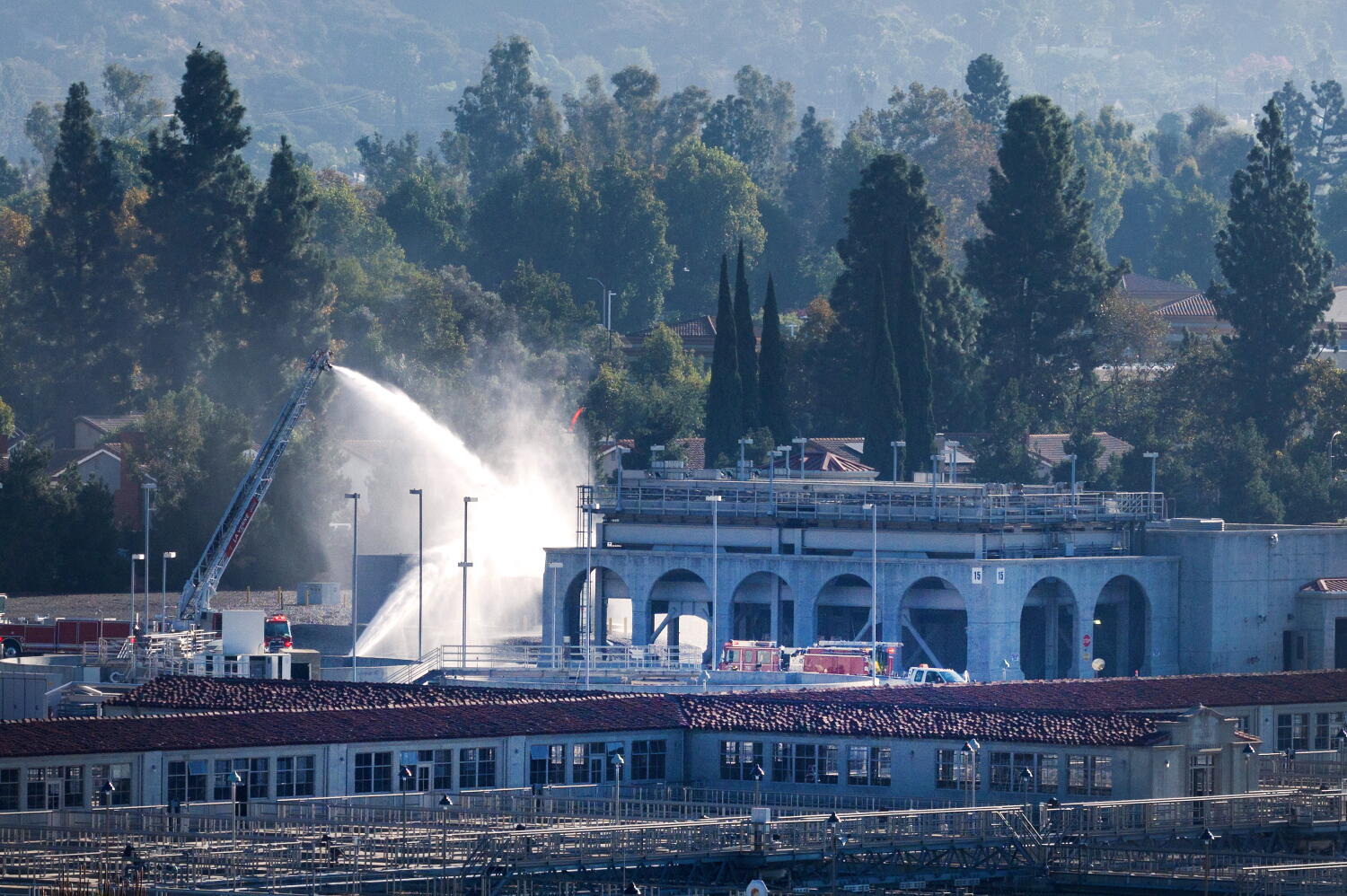
Emergency responders in La Verne began de-energizing a commercial lithium-ion battery system Thursday after a multi-day fire at a regional water treatment plant forced neighborhood evacuations and school closures. By Thursday afternoon, crews had brought the internal temperature of a second battery enclosure under control, allowing specialized technicians and first responders to isolate and de-energize individual cells.
The fire began shortly before noon Tuesday inside one of four 250-kilowatt battery container enclosures at the Metropolitan Water District of Southern California’s F.E. Weymouth Water Treatment Plant on Wheeler Avenue. Firefighters stabilized the initial enclosure, but extreme heat transferred to an adjacent container and triggered a secondary thermal runaway reaction in its battery modules.
The energy storage system became operational in June. It stores electricity from an on-site solar farm to power water treatment operations. La Verne Fire Department Battalion Chief Mark Savage said continuous air monitoring around the facility detected no hazardous toxic gas concentrations in surrounding neighborhoods. Localized evacuation orders remained in place as a precaution because of chemical off-gassing risks from battery fires.


Compromised lithium-ion cells can enter thermal runaway, an uncontrollable, self-sustaining chemical reaction marked by rapid temperature spikes. The process produces combustible and toxic vapors, including hydrogen fluoride, hydrogen chloride and carbon monoxide. Because the reaction can continue inside a battery system for days, firefighters often need sustained, intensive cooling to keep heat from spreading to contiguous storage cells.
Authorities restricted access to streets surrounding the municipal plant, prompting precautionary closures and schedule changes at local educational facilities, including campuses in the Bonita Unified School District.
The La Verne emergency has drawn attention to safety at commercial and industrial energy storage sites, which are located “behind the meter” at municipal, commercial or industrial facilities to meet local power needs rather than supply the broader high-voltage grid. Dustin Mulvaney, a professor of environmental studies at San Jose State University, said public policy discussions of battery hazards have largely focused on high-capacity, utility-scale projects. The emergency response and localized evacuations at the smaller La Verne facility, he said, point to a need for greater regulatory focus on distributed, lower-capacity energy storage sites.
California has expanded battery deployment to support Senate Bill 100, which requires 100 percent of retail electricity sales to come from renewable and zero-carbon sources by 2045. The state has built more than 10,000 megawatts of grid-connected battery capacity to store excess solar electricity generated during midday hours and discharge it during peak evening demand.
A large-scale fire at the Moss Landing Energy Storage Facility in Monterey County in January 2025 damaged approximately 55,000 battery modules. The fire prompted mandatory evacuations for roughly 1,500 residents, closed major transportation routes including Highway 1, and led to environmental assessments after reports of heavy metal deposition near the Elkhorn Slough estuary.
In response to recurring battery incidents, lawmakers in Sacramento have pursued tighter construction and operating standards for energy storage facilities. Senate Bill 283, authored by Sen. John Laird (D-Santa Cruz) and signed into law last year, requires developers to consult directly with local fire authorities and complete comprehensive fire inspections before operations begin. The law also requires compliance with National Fire Protection Association Standard 855, which governs the installation and protection of stationary energy storage systems.
A separate proposal, Assembly Bill 303, did not advance through the Legislature. Authored by Assemblymember Dawn Addis (D-Morro Bay), it would have given local governments mandatory oversight in permitting and established a 3,200-foot setback between battery installations and sensitive locations, including residences, schools, hospitals and protected habitats. Addis said she was disappointed the bill did not receive a committee hearing and intends to reintroduce safety legislation in the next legislative session. As California moves away from fossil fuel energy, she said, regulatory frameworks must ensure surrounding communities are not exposed to safety hazards from emerging clean energy infrastructure.
Administrative agencies, including the California Public Utilities Commission, the California Department of Forestry and Fire Protection (Cal Fire) and the California Energy Commission, have also updated state codes for energy storage facilities. Recent rules encourage lithium iron phosphate (LFP) chemistries, which are more thermally stable than traditional lithium nickel manganese cobalt (NMC) cells, and require improved spacing, physical blast-containment walls and specialized internal gaseous fire-extinguishing systems to prevent thermal cascading.