

A cascade of data breaches exposing the financial profiles of French cryptocurrency holders has triggered an unprecedented wave of violent crime across the country, shifting the threat landscape from digital theft to physical extortion.
French law enforcement recorded 90 criminal cases involving kidnapping, abduction, extortion, threats and violent theft tied to digital assets between Jan. 1 and mid-August 2026, according to figures provided by the Interior Ministry. The pace amounts to a new violent incident roughly every two and a half days. Police made 223 arrests during the period, and courts imprisoned 126 individuals through July.
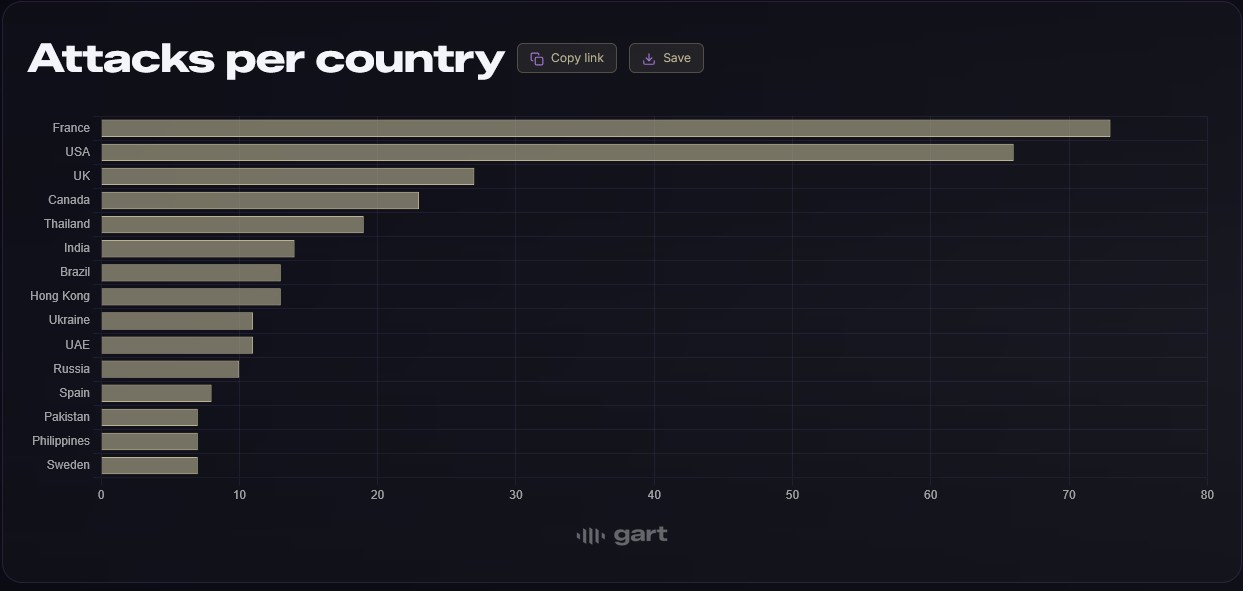
The ministry confirmed it cannot provide a year-over-year comparison because systematic tracking of these specific offenses only began on Jan. 1, 2026. However, independent security trackers indicate France now leads the world in physical attacks on crypto owners. Blockchain intelligence firm Gart.io logged 73 real-world attacks in the country this year, surpassing the United States at 66 and the United Kingdom at 27.


Criminals are not selecting targets at random. Of the victims whose residency is known, 93% were French nationals rather than wealthy tourists passing through Paris. More critically, attackers are increasingly bypassing wallet holders entirely to target their families. Globally, relatives and acquaintances accounted for roughly 25% to 30% of violent crypto incidents by early 2026. In France, that figure exceeded 40%.
This shift toward proxy targeting exposes the severe consequences of compromised personal data. In May 2026, six men attempted to abduct the wife of The Sandbox co-founder Sébastien Borget from their home in Villenoy. One suspect posed as a delivery driver to coax her into opening the gate. In August, a couple living in rural France endured three separate home invasion attempts after purchasing a property previously owned by crypto millionaires whose tax records and address had been published on dark web forums.
The violence escalated dramatically last year when kidnappers in Paris abducted the father of a crypto entrepreneur, held him for two days, severed part of his finger and mailed it to his son alongside a demand for $5.6 million in digital currency.
Security researchers trace the acceleration of these crimes directly to institutional data failures. Eric Jardine, head researcher at Chainalysis, assessed that a significant data breach likely catalyzed the surge. His analysis points to a 2024 compromise within the French tax authority, where an official in the Paris region leaked personally identifiable information, financial records and crypto holding details of French taxpayers. Chainalysis data shows physical attacks spiked immediately following late November 2024.
A second major exposure occurred in January 2026 when Waltio, a crypto tax reporting platform, disclosed a breach affecting approximately 50,000 users. Combined, these leaks provided attackers with precise dossiers detailing who holds digital wealth, where they live and how much is at stake.
The crisis has intensified scrutiny of European regulatory frameworks. DAC8, the European Union directive expanding tax reporting and information-sharing requirements for crypto users, mandates extensive data collection by centralized entities. Francis Pouliot, founder of Canadian exchange Bull Bitcoin, has repeatedly challenged the policy in France, arguing that mandatory disclosure regimes transform customer identification protocols into vulnerabilities that endanger users.
Jameson Lopp, a prominent Bitcoin security advocate who maintains a long-running directory of physical crypto attacks, has documented 365 cases across 60 countries since 2014. France currently tops his global leaderboard. While wrench attacks — the industry term for using physical force to compel a victim to surrender private keys or execute transfers — have historically concentrated in major capitals, Chainalysis reports the violence has now spread to Strasbourg, Marseille, Grenoble, Toulouse and Nantes.
Standard operational security practices such as hardware wallets, multisignature setups and seed phrase protection defend against remote hacking but offer no resistance once an attacker possesses a victim’s home address and net worth. Cryptography secures the network; it cannot stop physical coercion.
French authorities are restructuring their response to match the sophistication of the threat. Investigations are now coordinated through JUNALCO, the national jurisdiction specialized in organized crime, reflecting law enforcement’s assessment that these incidents represent structured criminal enterprises rather than opportunistic robberies.
JUNALCO continues to process the 223 arrests made since January as investigators work to dismantle the networks exploiting the 2024 and 2026 data breaches.



