School Backpack Safety Warnings Issued as Dual Tech and Textbook Loads Strain Students
Experts highlight hidden seatbelt hazards and physical strain as students balance textbooks and laptops.
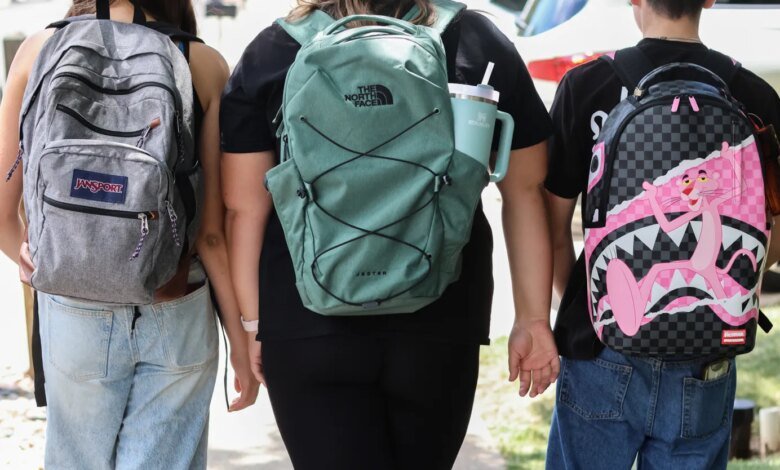
As school districts across the United States balance digital learning with a return to traditional textbooks, pediatric health experts and educators are warning that overloaded backpacks pose expanding safety risks for students. Beyond traditional muscle strain, health officials highlight critical hazards including altered body posture, heightened injury severity during falls, and compromised seat belt effectiveness in motor vehicles.
According to data from the U.S. Consumer Product Safety Commission, thousands of school-age children receive emergency room treatment annually for backpack-related strains, sprains, and back pain. Dr. Sadika Kendi, a physician who chairs the American Academy of Pediatrics (AAP) injury-prevention efforts, emphasized that wearing a backpack inside a moving vehicle presents an immediate physical hazard. The bulk of a backpack interferes with proper seat belt placement, preventing safety restraints from functioning effectively during a sudden stop or collision.
“Don’t wear it in a car or any form of transportation while that car is moving,” Kendi said. “It’s just incredibly dangerous.” She noted that while severe back injuries from carrying bags are relatively rare, a heavy pack drastically increases physical trauma during accidental falls. “It’s worse if, for example, they trip and fall and they have a huge, heavy backpack on their back. Then that’s just more weight that could increase the severity of an injury,” Kendi added.
The physical burden on students has intensified as some school systems alter their instructional materials. In Fairfax County, Virginia, the school district recently reintroduced physical math textbooks following community opposition to pure digital learning. Alix Fetch, a spokesperson for Fairfax County Parents for Intentional Technology, noted that while the move was a victory for screen-time management, it created hard decisions regarding daily bag weight. Fetch observed that her 7-year-old child already carries lunch, water, and paperwork, which becomes burdensome during classroom transitions. “Kids are still kids. There’s food in their backpack and water, and they’re scrunching up papers,” Fetch said.
In Phoenix, Arizona, history teacher Samantha Ness, who has taught for roughly 10 years, observed that students are required to carry laptops and chargers daily alongside basic supplies. However, Ness noted that older students frequently compound bag weight by using backpacks as personal storage units rather than academic toolkits, carrying non-essential items like makeup, nail polish, and hair dryers. “They’re using their backpacks more as purses and like storage than they are actually using them for school,” Ness said, advising parents to conduct regular home audits of daily supply checklists.
While health guidelines historically recommended limiting a backpack’s weight to 10% or 15% of a child’s total body weight, Kendi noted that limited clinical evidence exists to support a universal threshold. Because children vary significantly in physical strength, growth rate, and daily routine, medical consensus stresses keeping bags as light as possible rather than relying on a fixed percentage. Physical therapists warn that heavy loads force children to lean forward, causing spinal compression and altered muscle activation across the lower back and neck.
To minimize physical strain, the AAP recommends selecting bags with two wide, padded shoulder straps, a padded back panel, internal weight-distribution compartments, and supportive chest or waist straps. Students should be taught to bend at the knees rather than the waist when lifting heavy loads. While wheeled backpacks offer an alternative for students recovering from physical injuries, safety experts caution that rolling bags create tripping risks in crowded school hallways and present safety hazards on stairways.