

U.S. spot Bitcoin exchange-traded funds hemorrhaged nearly $730 million over two sessions this week, marking the sharpest institutional retreat from the asset class since late June. The consecutive outflows — $484.9 million on Wednesday and $244 million on Thursday — coincided directly with the 10-year Treasury yield climbing to 5.32%, a level that historically forces portfolio managers to reassess exposure to non-yielding speculative assets.
The timing reflects a broader repricing of risk across global markets following the release of Federal Reserve meeting minutes that signaled another interest rate increase before the end of 2026. When benchmark government debt offers yields above 5%, the opportunity cost of holding volatile digital assets rises substantially. Institutional allocators who drove the January 2024 launch of U.S. spot Bitcoin ETFs — primarily products from BlackRock, Fidelity, and Ark Investments — tend to operate within strict risk-parity frameworks that automatically reduce crypto weightings when fixed-income returns spike.
Bitcoin traded at $82,837 on Friday, up 1.38% after touching an intraday low of $80,427 the previous session. That Thursday floor was the lowest price recorded since early September. The bounce stabilized the total cryptocurrency market capitalization at $2.89 trillion, though the sector remains more than $110 billion below where it stood just seven days prior when aggregate valuations briefly exceeded $3 trillion.


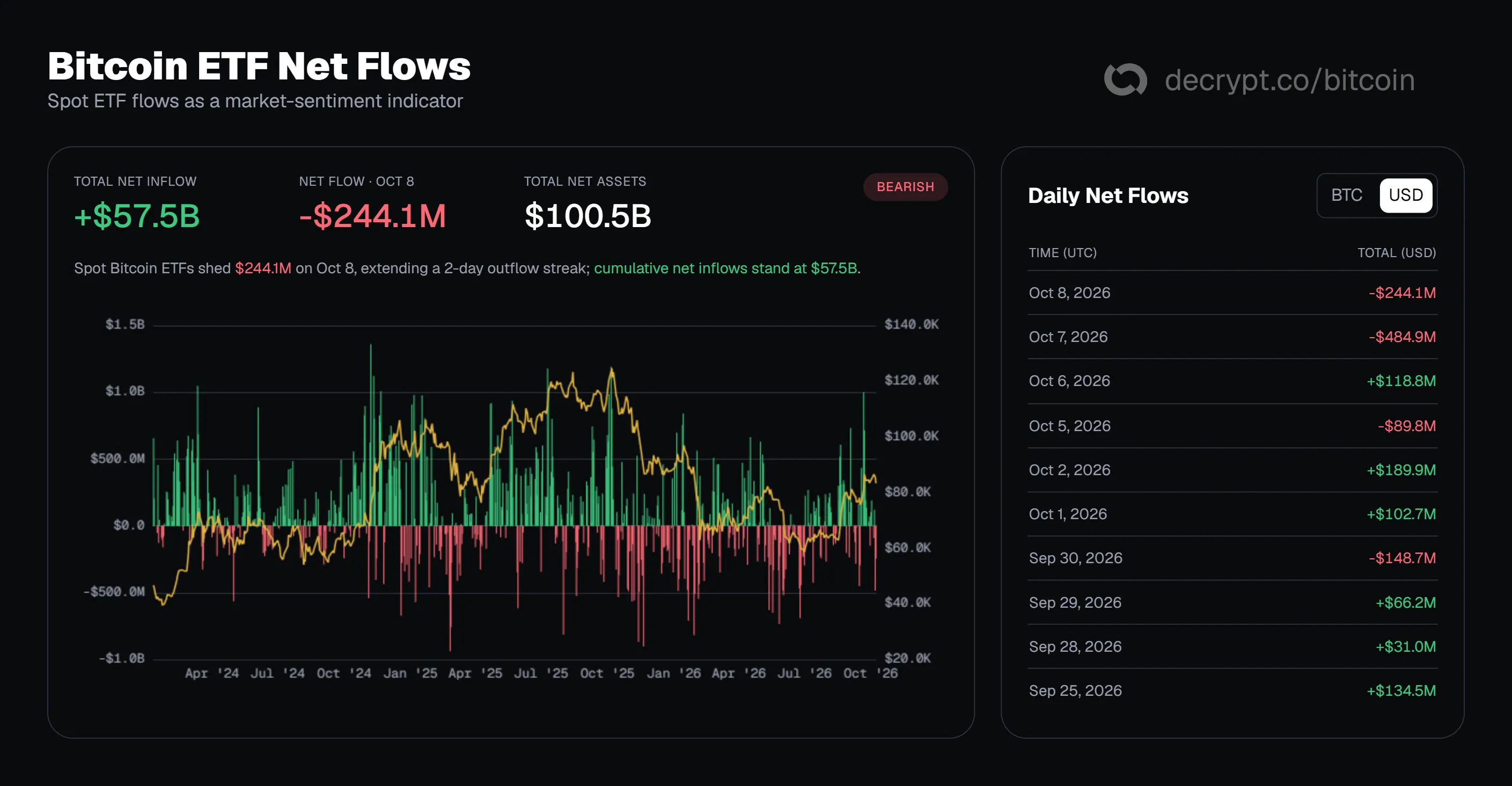
Market sentiment has cooled in tandem with prices. The Crypto Fear & Greed Index registered a neutral 56 on Friday, a sharp reversal from the 71 reading recorded on October 2 that placed investor psychology firmly in the “greed” category. Such rapid shifts in sentiment often precede periods of range-bound trading rather than immediate directional breakouts.
Prediction markets reflect growing expectations for further downside. Traders on Myriad, a forecasting platform operated by Dastan, are pricing a 67% probability that Bitcoin will trade at or below $80,000 before October ends. Contracts resolving at $77,500 carry 40% odds, while a drop to $75,000 holds a 24% implied probability. A separate weekly market assigned only 49% odds to Bitcoin finishing its current seven-day cycle above $87,500.
From a technical perspective, the daily chart presents conflicting signals. The Average Directional Index reads 37.9, well above the 25 threshold required to confirm a definitive trend is in place. Directional indicators currently favor buyers over sellers, suggesting the broader bullish structure established earlier this year remains intact despite the recent drawdown. However, the Relative Strength Index has fallen to 51.2, indicating that the intense buying pressure that characterized September has fully dissipated into neutral territory.
Shorter timeframes paint a more cautious picture. On the four-hour chart, price action continues to print below the 50-period exponential moving average, meaning intraday momentum has not yet shifted back in favor of bulls.
Luke Deans of Bitwise Europe identified the $83,000 region as the critical battleground for the near term. This price zone aligns both with the estimated average cost basis for institutional ETF buyers and a prior structural higher-high. Reclaiming and holding above this confluence would open a path toward $84,433. The definitive ceiling for any sustained recovery remains the September peak of $87,354.33, a level bulls must close above on a daily timeframe to invalidate the current pullback thesis.
Friday’s daily candle opened at $81,711 and established an initial trading range between $81,553 and $83,443 as derivatives desks digested the overnight macroeconomic data.



