

Four wallets deployed 40x leverage to short nearly 150 Bitcoin on Hyperliquid moments before a flash crash wiped out over half a billion dollars in long positions across the crypto market Wednesday.
The coordinated bets, totaling 148.49 BTC and funded entirely with USD Coin (USDC), appeared onchain just before the overnight sell-off accelerated. On-chain analytics platforms including Lookonchain flagged the timing, intensifying scrutiny of decentralized perpetual futures exchanges where high-leverage trades execute without the identity verification requirements standard on regulated venues.
Hyperliquid operates as a decentralized exchange built on its own Layer-1 blockchain, allowing traders to open derivatives positions directly from self-custodied wallets. Unlike centralized platforms such as Binance or Coinbase, which have progressively capped maximum leverage following regulatory pressure from the Commodity Futures Trading Commission and global counterparts, decentralized protocols frequently permit extreme risk multipliers. A 40x leveraged position requires only 2.5% margin, meaning a price move of roughly 2.5% against the trader triggers automatic liquidation. When large players use such leverage to initiate shorts ahead of a predictable cascade, the mechanics can resemble front-running or deliberate liquidity hunting.


Bitcoin fell as low as $83,560 during the two-hour descent, registering a 2.3% drawdown on hourly charts tracked by TradingView. The drop flushed $550 million in cumulative long liquidations across 21 exchanges monitored by CoinGlass within a 24-hour window. Long liquidations occur when traders who borrowed capital to bet on rising prices are forced to sell their holdings at market value to cover losses, creating a feedback loop that drives prices down faster than organic selling would.
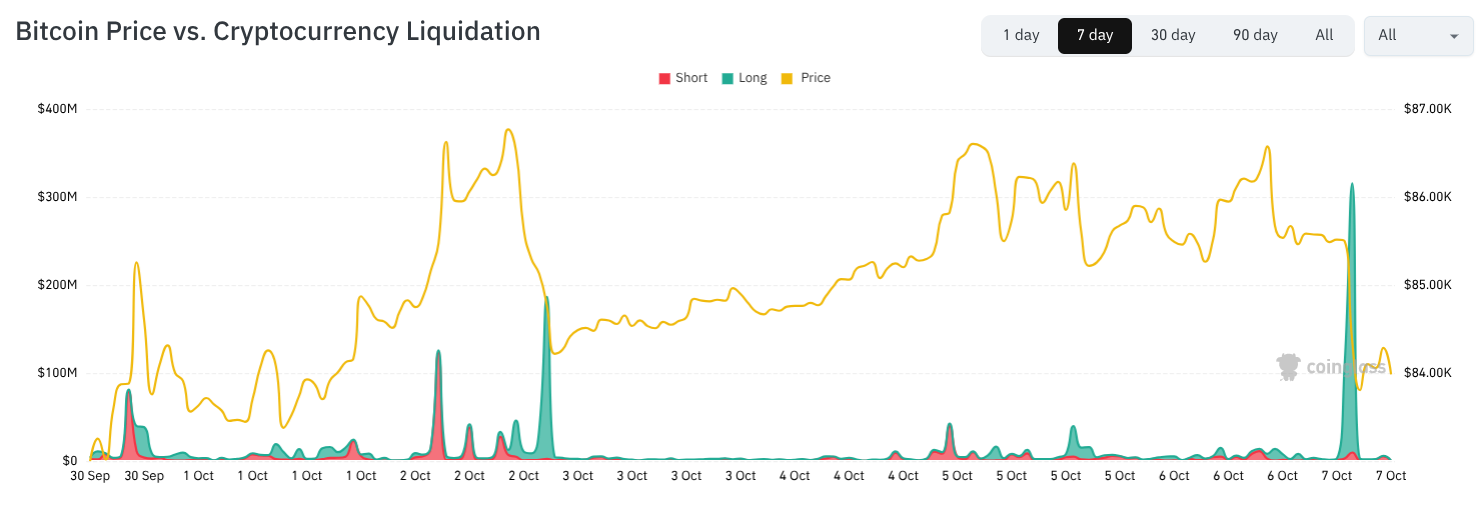
The vulnerability to a sudden downside move had been building throughout Tuesday. Ask-side liquidity on spot order books thickened significantly above $86,500, effectively capping upward momentum and trapping bullish traders in a tightening range. When support gave way, the lack of immediate buyers exacerbated the speed of the decline.
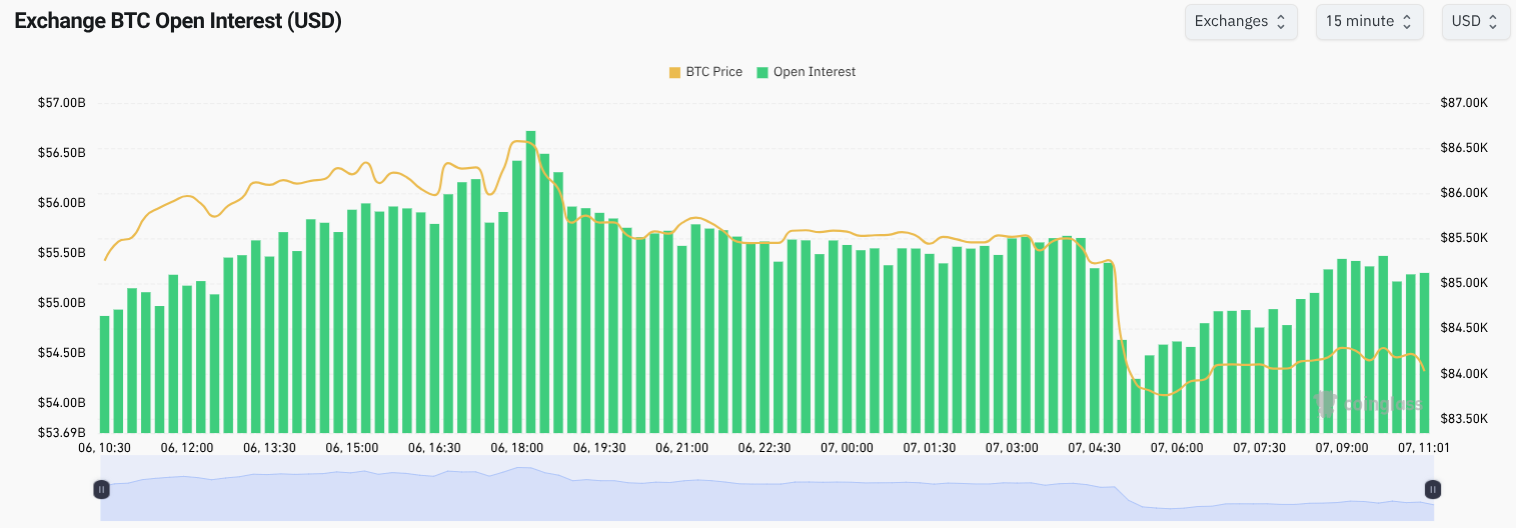
Despite the violent flush, derivative markets signaled rapid stabilization. Open interest — the total value of outstanding futures and options contracts — rebounded from approximately $54.2 billion to $55.3 billion in the six hours between 4 a.m. and 10 a.m. UTC. This swift accumulation of new positions suggests institutional and sophisticated retail participants viewed the dip as a localized clearing event rather than the start of a broader structural reversal. Historically, sharp open interest recoveries following mass liquidations indicate that sidelined capital was waiting for lower entry points.
Technically, Bitcoin found a floor precisely at its 21-day simple moving average near $83,850. Short-term algorithmic trading systems heavily reference this dynamic trendline, and holding it prevented a deeper breakdown. Should the asset lose this level on a sustained basis, chart structures point to $82,500 as the next critical defense zone. That price point anchors an inverse head-and-shoulders pattern developing on the weekly timeframe, a formation last tested on Sept. 28 that typically signals trend continuation if the neckline holds.
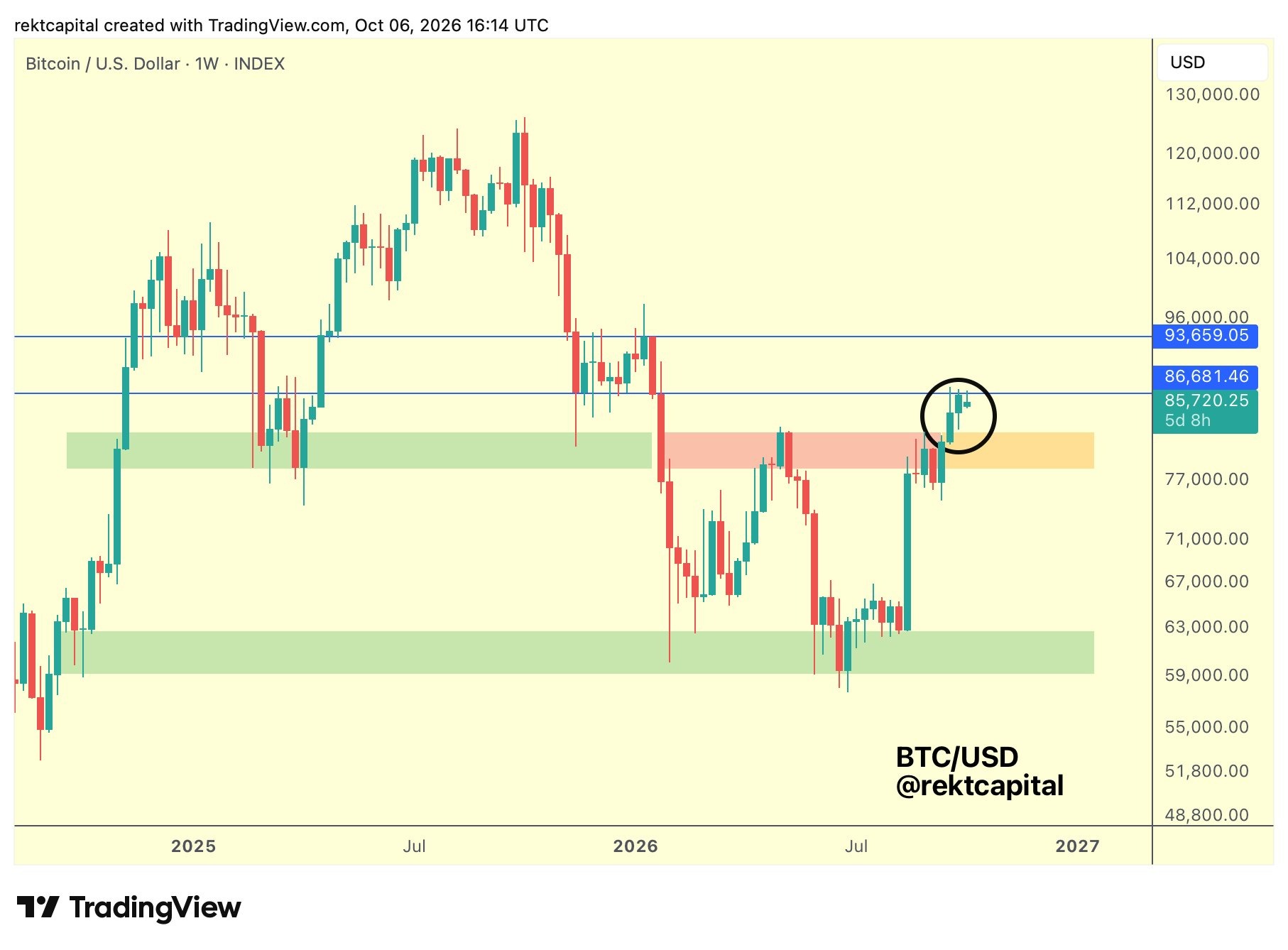
Regaining bullish momentum will require more than defending support. Market analyst Rekt Capital noted that bulls must force a daily or three-day candle close above $86,700 to validate any continuation thesis.
Broader network activity offers a counterweight to the derivatives turbulence. Whale wallets recently accelerated stablecoin deposits to major exchanges while simultaneously pulling spot Bitcoin off Binance at rates unseen since mid-2023, indicating that large holders were accumulating underlying assets even as leveraged paper markets experienced severe volatility.



