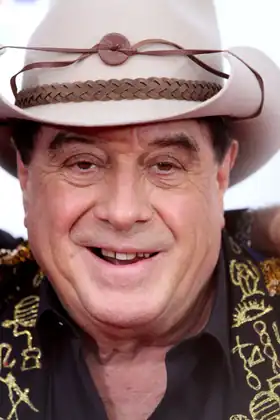
The television was black and white, the hour was six o’clock on a Sunday, and the whole week seemed to narrow to it. For one Australian who posted about it on Monday, that hour is still the clearest thing about being a kid in the early seventies. “Watching Countdown on black and white tv in the early 70’s is part of my core childhood memories,” the Reddit user factsnack wrote. “Thanks Molly.” Ian “Molly” Meldrum, the man on that screen, died at 5.30am on Monday at Epworth Hospital in Richmond, Melbourne, after a long period of ill health. He was 83.
By 1977, three million Australians were watching Countdown, in a country of fourteen million, and the ratings sat above 20. The show was the ABC’s biggest. Sunday at six was the hour the whole country kept free. Meldrum had been hired to pick the acts. When he liked one, he told the viewers to do themselves a favour. The ABC’s rules would not let him tell anyone to buy a record, so the catchphrase did the job instead, and for thirteen years it worked.
The hiring itself happened the way a lot of Countdown happened, by accident in a pub. The show’s executive producer, Michael Shrimpton, told the ABC in 2003 that he and a fellow producer were meeting in a Melbourne pub to talk about who to hire as the show’s talent scout. Meldrum drove up onto the footpath outside. He got the job, first as talent coordinator and then on air. He presented the music news segment. In 1969 he had produced Russell Morris’s “The Real Thing”, a six-minute record built in a Melbourne studio on the country’s first eight-track machine. It cost A$10,000, then the most expensive single ever recorded in Australia. It spent two weeks at number one and finished the year as the fourth best-selling single of 1969. Countdown had arrived into a vacuum: the share of Australian acts in the charts had hit an all-time low by 1973, the year before it premiered. A new episode went out every Sunday at 6pm and was repeated the following Saturday at 5pm, so a song got two chances a week to find the country. Colour television reached Australia four months after the show began, and on 1 March 1975 Countdown’s ninth episode became the ABC’s first scheduled program broadcast in colour. The first episode had already shown the way, opening with a music video, Paper Lace’s “The Black-Eyed Boys”. Suzi Quatro arrived in person that December as the show’s first international guest.


ABBA’s “Mamma Mia” was not even considered a single by the group until Meldrum played it again and again on Countdown, and it spent ten weeks at number one in Australia. “Fernando” did fourteen weeks at the top. It stayed on the chart for forty weeks. The record stood for forty-one years.
“Growing up with Countdown on Sunday evenings was such a huge part of my childhood,” a Reddit user called Lastbalmain wrote on Monday. “Molly was always first at finding new artists, bringing music to our ears we may not have ever heard of without his ‘do yourself a favour’ segments.” Then came the request. “How about ABC does us all a favour and put Countdown on re-runs? I’d watch that!” The ABC has answered that request once. Classic Countdown returned in September 2017 for thirteen episodes in the original Sunday 6pm slot, with the show’s original announcer, Gavin Wood, back behind the microphone.
“He was something very rare on TV, he was himself,” another viewer, SkeltonKnaggs69, wrote. “Watching him host Countdown it’s easy to see the fun he was having. Not media trained and restricted to a certain way of presenting like today.” The same viewer remembered the tapes: “the only reason we still have a lot of those classic Countdown episodes is because Molly loaded the tapes up in the boot of his car to prevent them being erased for re-use.” The ABC did erase at least a hundred episodes from 1974 to 1978. Five hundred reels were pulled in an economy drive. Meldrum called it unforgivable. Elton John, speaking at Meldrum’s Logies Hall of Fame induction in 2012, said, “I know I speak for many artists and music lovers around world when I say, ‘Thank you. There’s no-one like you.'” On Reddit on Monday, a user called TasmanianDevilicious said the same thing in the viewers’ own words: “Countdown was such a huge part of my childhood and teen years. Thank you for the music Molly xx”
John Farnham hosted Countdown’s first episode in November 1974. He performed “You’re the Voice” as the final song on 19 July 1987, and that song had already spent seven weeks at number one the year before. Kylie Minogue co-hosted episode 562 in July 1987, with “Locomotion” played as a video, in the last episode ever to have a live studio audience. “Locomotion” spent seven weeks at number one and became the highest-selling single of the 1980s in Australia. In December 2011 Meldrum fell about three metres from a ladder at his Richmond home while putting up Christmas decorations. He fractured his skull and spent five weeks in a coma. He recovered. He joked about it the way he joked about most things. “I guess the fall made me realise I wasn’t bulletproof,” he said in 2023. “You realise that life is short.” The Seven miniseries about his life drew 1.79 million viewers for its first episode in 2016, programmed in the old Sunday 6pm slot.
A bronze statue of Molly Meldrum stands near the Corner Hotel in Richmond. He is survived by his two brothers, his partner Yan Wongngam, his adopted son Morgan Scholes and Scholes’s son Jason.