Toledo Ordered 983 People Out on a Single Unexplained Word
From 9:25 p.m. to 4:24 a.m., the evacuation circles in north Toledo kept widening — half-mile, mile, three miles — in fog that made the plume invisible, while the only public account of the cause stayed one word long.
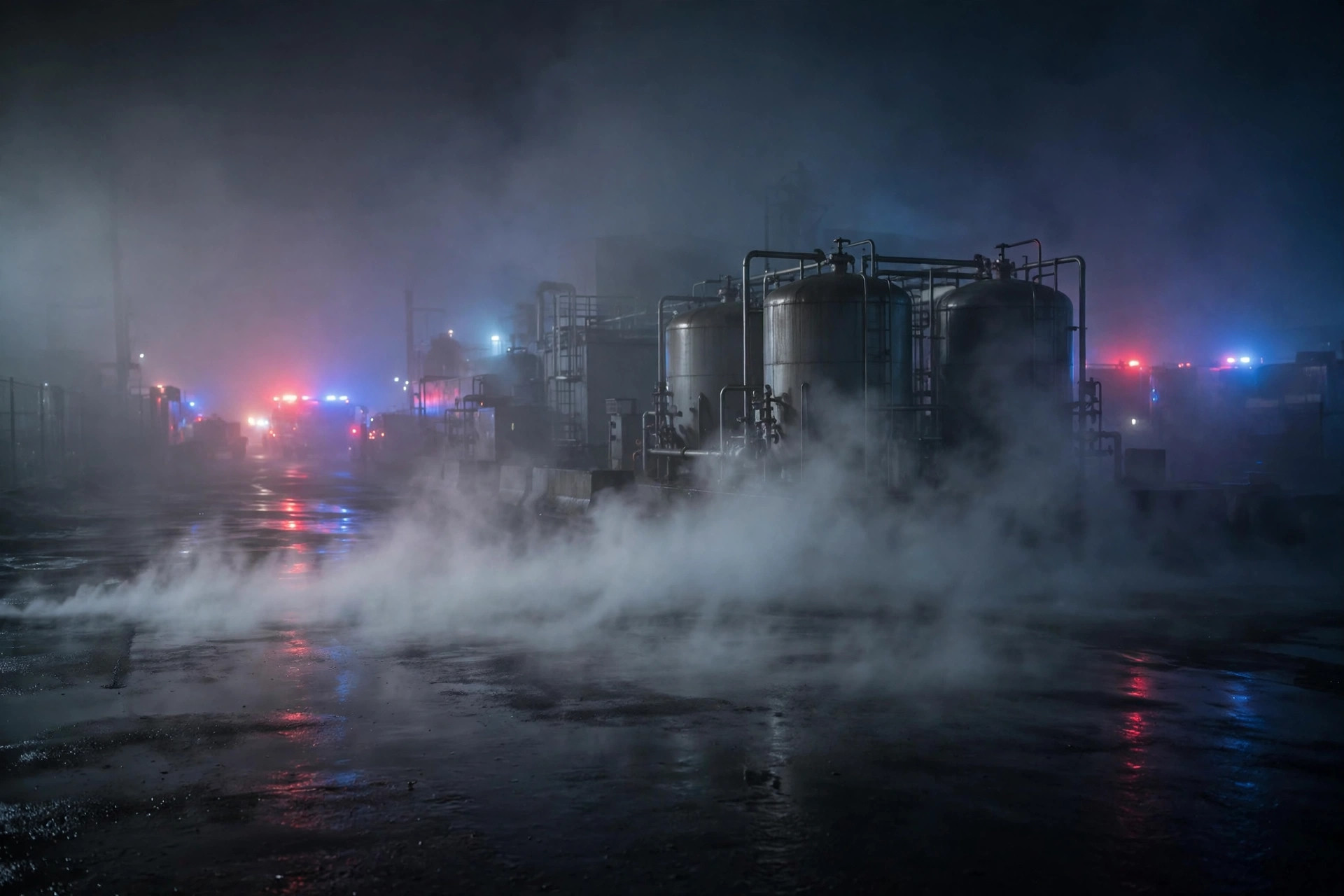
The fog came first, or the chemical did. Nobody in north Toledo could tell which. On Tuesday night, dense fog settled over the city while a chemical plume rose somewhere inside it, and the city’s guidance was plain: don’t judge the air by looking at it. What mattered was where your address fell on the map. If it fell inside the circle, you left.
The first circle was small. Emergency crews were dispatched to a Progress Avenue facility at about 9:25 p.m., according to The Toledo Blade, and found a tank outside the building leaking chemical onto the ground. Toledo Fire & Rescue Pvt. Sheldon Collins briefed reporters through 13 Action News that night. The exact chemicals in the air, he said, were not known at the time. Neither was the building, quite. The first alerts named Sterling Pipe & Tube at 1050 Progress Avenue; by morning the city was naming the MC Tank terminal at 1266 Progress Avenue instead.

At 10:48 p.m., the circle grew. Lucas County’s emergency alert system, which sends alerts on behalf of Toledo Fire & Rescue, expanded the evacuation from a half-mile radius to a full mile. “UPDATE: A HAZARDOUS MATERIALS release has occurred at 1050 Progress Avenue,” the alert read. “Toledo Fire has expanded the EVACUATION from one-half mile to one-mile. Individuals within one mile of 1050 Progress Ave., Toledo, should EVACUATE IMMEDIATELY.”


About 300 people had been inside the first circle; the second one held 983, including two whole neighborhoods. The Raintree Village mobile home park and the Alexis Addition sat squarely inside it, and Washington Township officials went into Raintree Village to knock on doors and get people out. At the Meijer parking lot off East Alexis Road, TARTA buses idled while Red Cross workers set up for whoever couldn’t drive themselves out. Shoreland Elementary opened its doors as a shelter. Toledo Fire & Rescue posted the night’s instructions on Facebook: “There is currently an active HAZMAT incident in the area of Enterprise Blvd. and Progress Ave. in Toledo. Residents and motorists are urged to avoid the area until further notice. There is a one mile evacuation radius from the incident. Shelter in place by remaining indoors, closing all windows and doors, and turning off ventilation systems that bring in outside air.”
The orders kept widening.
At 4:24 a.m., everyone within three miles was told to shelter in place: stay inside with the windows closed, and turn off anything that pulls outside air in. The shelter-in-place zone reached more than 50,000 people, according to the Associated Press, and it crossed the state line. Bedford and Erie townships in Michigan issued their own shelter-in-place guidance, and schools closed on both sides of the border. The Toledo Assembly Complex, where Jeep builds the Wrangler about a mile from the terminal, had already cleared its north plant around 11 p.m. Tuesday; Stellantis canceled Wednesday’s first and second shifts. Its south plant wasn’t running that week anyway.
The circles kept growing for a reason, and it wasn’t only the chemical. Dense fog made it hard for fire officials to gauge how far the exposure risk extended, and that uncertainty helped prompt the wider order. Crews from 13 Action News at the scene reported haze in the air, a chemical smell, and the plume cutting visibility on the roadways, with drivers urged to slow down. One of the station’s meteorologists, Ross Ellet, told his Facebook followers the chemical was spreading west. Enterprise Boulevard closed between Stickney Avenue and Benore Road, and the railroads near the plant shut down. So many residents called 911 about the smell that dispatchers were overloaded, and the fire department asked the public to stop calling and use Engage Toledo instead.
Containment had already failed. Commanders chose not to send crews toward the tank. They would let the chemical finish reacting. The reaction inside the compromised tank would run its course, rather than risk an intervention that could set it off. Mayor Wade Kapszukiewicz warned Wednesday that the tank still carried an explosion risk within about 12 hours of the incident. “We don’t have an exact timeline, but we estimate it could be another 6-16 hours before we issue updated guidance,” the city’s communications chief, Rachel Hart, told reporters that afternoon. Air monitoring fell to the U.S. EPA, and Ohio’s EPA deployed its emergency response office. “We ask everyone to remain calm, follow the directions of emergency personnel, and avoid the affected area to allow first responders to safely manage the incident,” the fire department said in a social media post. “Additional information will be shared as it becomes available.”
On Wednesday the cause finally got a name. It was one word. Ohio EPA spokesman Bryant Somerville said the release “came from a 5,500-gallon tank because of an error that occurred when the material was being transferred.” The chemical was glycidyl methacrylate, flammable, with a noticeable odor, an irritant to eyes, nose, mouth and skin, with headaches, dizziness, tiredness, nausea and vomiting as the signs of overexposure. MC Tank Transport, the Arkansas-based company that runs the terminal as a subsidiary of The Kenan Advantage Group, said it was cooperating with authorities and had mobilized specialized emergency response crews. It is working with the Red Cross on lodging and transportation for displaced residents.
Neither the agency nor the company has described the error.
The mayor was blunt at his Wednesday news conference: “We don’t know what caused this. We just know we’re responding to it.”
The circles started shrinking Wednesday evening. At 5 p.m. the city lifted the shelter-in-place order and pulled the evacuation zone back to a half-mile; by Thursday morning it was a quarter-mile, covering 64 households. Hospitals had treated 57 people for symptoms tied to the release, seven were still being treated Thursday afternoon, and none was in serious condition. A Lucas County sheriff’s deputy who fell ill during the response was among the earlier patients. Thursday afternoon, WTOL reported that crews approached the facility for the first time. The tank’s temperature had dropped significantly and less gas was venting. The water was never contaminated. The symptom-tracking hotline, 419-779-7089, was still taking calls.