

A $337 million expansion of the Colburn School of Performing Arts is entering its final construction phase in downtown Los Angeles, delivering a 1,000-seat venue designed to fill a critical gap in the city’s live performance infrastructure. Terri and Jerry Kohl Hall will host its inaugural concert on Sept. 25, opening a weekend of performances that will also activate a new dance facility across the 100,000-square-foot addition.
Architect Frank Gehry conceived the project as an intimate counterpart to his nearby Walt Disney Concert Hall. Where Disney Hall accommodates 2,265 patrons in a traditional vineyard layout, Kohl Hall uses an in-the-round configuration to physically close the distance between artists and audiences. The stage matches Disney Hall’s dimensions and includes a full orchestra pit, allowing the space to support large-scale symphonic, operatic, and dance productions without sacrificing proximity.
Los Angeles has historically lacked mid-capacity classical venues. The Colburn campus already operates the 415-seat Herbert Zipper Concert Hall, while the Dorothy Chandler Pavilion seats roughly 3,200 and the Peacock Theater at L.A. Live holds 7,100. A 1,000-seat room targets a specific commercial and artistic sweet spot for touring ensembles, chamber groups, and jazz programs that outgrow smaller recital rooms but cannot justify the overhead of a major civic auditorium.


Beginning next year, the Los Angeles Chamber Orchestra will establish its permanent home inside the new hall. LACO operates with approximately half the musician roster of the Los Angeles Philharmonic, making the 1,000-seat capacity acoustically and financially viable for its programming. The residency launches with newly commissioned fanfares by prominent film composers, including a piece by John Williams curated by Seth MacFarlane.

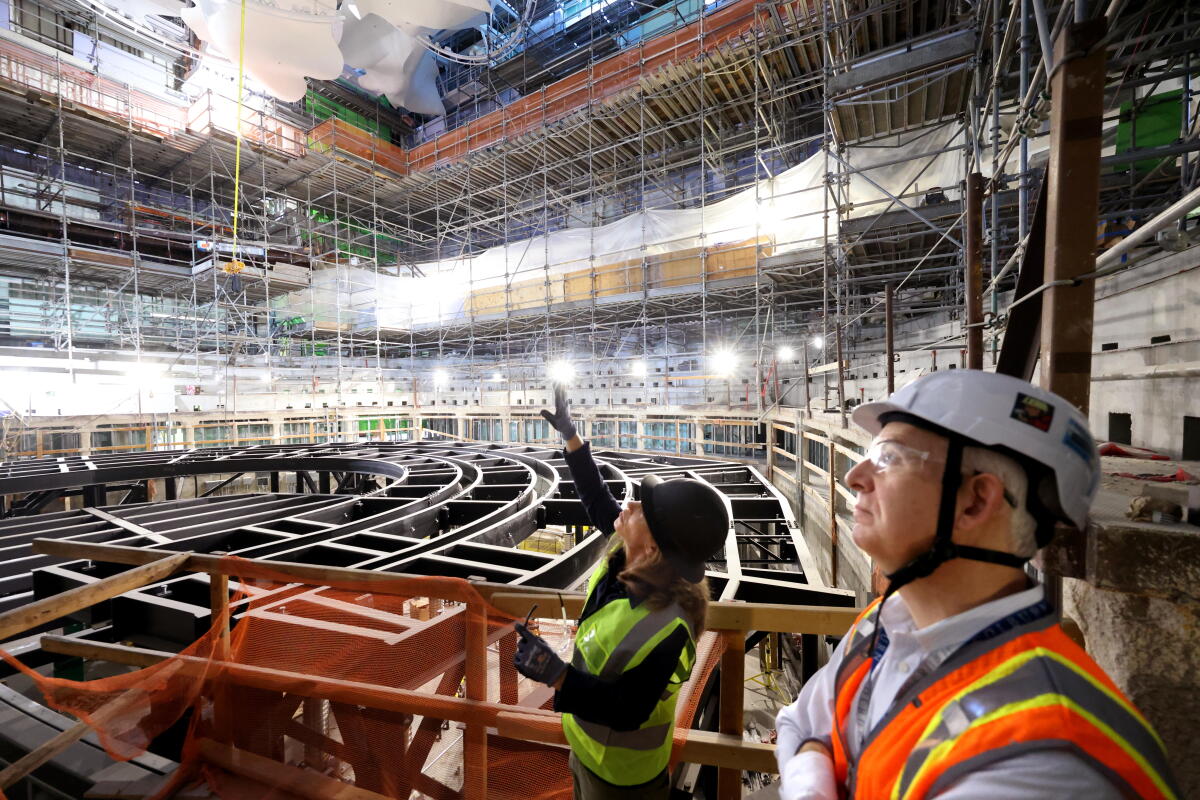
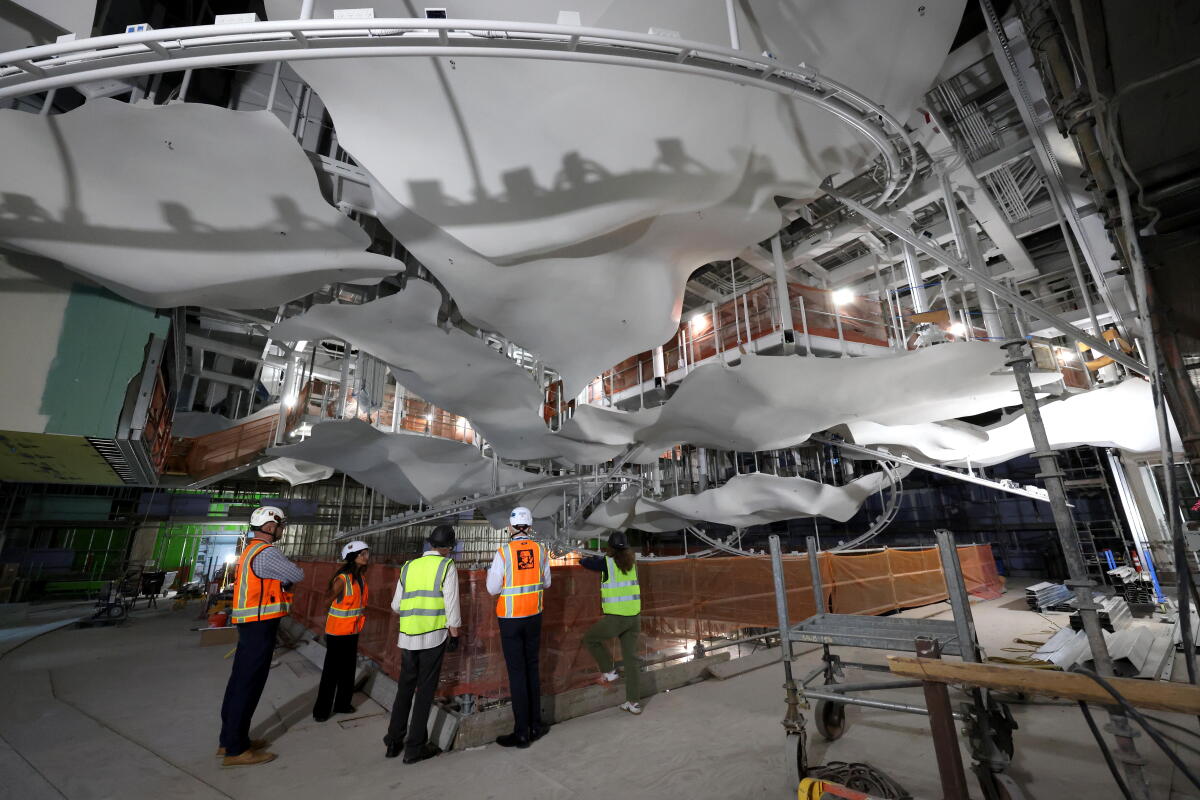
Acoustic precision drove much of the engineering. An array of steel clouds packed with concrete currently hangs from the ceiling, fabricated in the Netherlands by a shipbuilding firm that transitioned into complex architectural steelwork using digital modeling data. These structures are designed to diffuse sound evenly throughout the circular seating bowl. Yasuhisa Toyota, the Japanese acoustician who shaped the sound profile of Disney Hall and virtually every subsequent Gehry concert venue, engineered the room’s audio environment.
The exterior distinguishes itself from the stainless steel curves of Disney Hall through a luminescent pink metal cladding coating designated Pink Kandi. The visual departure signals the building’s distinct identity within Gehry’s growing footprint on Bunker Hill.
Kohl Hall represents the third Gehry-designed structure on the hill, joining Disney Hall and Grand LA, a $1 billion mixed-use residential, hotel, and retail complex developed by Related Companies. This concentration of work by a single Pritzker Prize-winning architect transforms Bunker Hill into one of the most architecturally unified cultural districts in the United States, comparable to the density of signature buildings found in Bilbao, Spain, where Gehry’s Guggenheim Museum reshaped the city’s global profile.
The expansion extends beyond orchestral music. A new Dance Center doubles the instructional and performance footprint of the school’s Trudl Zipper Dance Institute, adding four professional-size rehearsal studios and a 100-seat theater dedicated to dance.
Colburn officials project the hall will host more than 200 events annually. Programming will serve the school’s symphony orchestra, youth string programs, bands, and children’s choirs, alongside outside rentals for independent classical and jazz concerts. Founded in 1950 and relocated to its current downtown site in 1998, the institution now serves more than 2,000 students ranging from middle school through college age.
Gehry Partners chief of staff Meaghan Lloyd confirmed the design prioritized reciprocal energy between the stage and the seats, aiming for an environment where performers and audiences register each other’s reactions directly.
The Colburn School announced the Sept. 25 opening date on Tuesday.



